Introduction to Linear Algebra
What is Linear Algebra?
- Solving Systems of linear equations
- In general, the study of linear transformations of vector spaces
Algebraic Representation
- Solving Systems of Equations Through Simultaneous Addition/Subtraction
Example 1. Solve the System
	x - 2y = 4
	3x + y = 5
What I'm starting off with is multiplying the 1st equation by a multiple of the x variable of the second equation in order to eliminate the first variable.
The system of equations then becomes
You then subtract the second equation from the first to get
to get
You can then substitute this back into the original system of equations to solve for x
The only and final solution to this equation then becomes
Example 2. Infinitely Many Solutions
	-x + 2y = 2 (1)
	3x - 6y = -6 (2)
Using the same addition/subtraction method as above, you first multiply the eqn.(1) by 3 The System of equations then becomes
On adding the two equations to solve for y, you get Which means that there are infinitely many solutions.
In order to get a solution to such equations you can parameterize the equation (Theres more about parameterization later on). Lets assume , or any number. That way:
Therefore the solution to this system of equations is
Example 3.No solutions
	2x - y = 4
	2x - y = 5
Lets just start with subtracting the two equations
You then end up with This system of equations has no solutions.
From these 3 examples we can end up with a set of guiding questions to approach problems: Given a set of equations:
- Are there any solutions to this set?
- If so, how many?
- How can we describe the solutions?
- Algebraically
- Geometrically
Example 4. 3 equations, 3 unknowns
	a + 0b - 3c = -2
	3a + b - 2c = 5
	2a + 2b + c = 4
Step 1. Lets start off by eliminating in the 2nd and 3rd equation by subtracting a multiple of the 1st equation.
Subtracting the 2nd from the multiple of the first
Subtracting the 3rd from the multiple of the first
This leaves the system at
Step 2. Eliminate in the 3rd equation by subtracting a multiple of the second equation
This leaves the system at
Note: The system at this point is called a triangular system.
Step 3. Solve for all variables.
You can now take from that last system On substituting in equation 2
Then taking and to solve for
Therefore the final solution to this system is
Geometric Representation
- Geometrical representation of an equation is a line in the 2D space
The solution to system of such equations is the intersections of the lines.
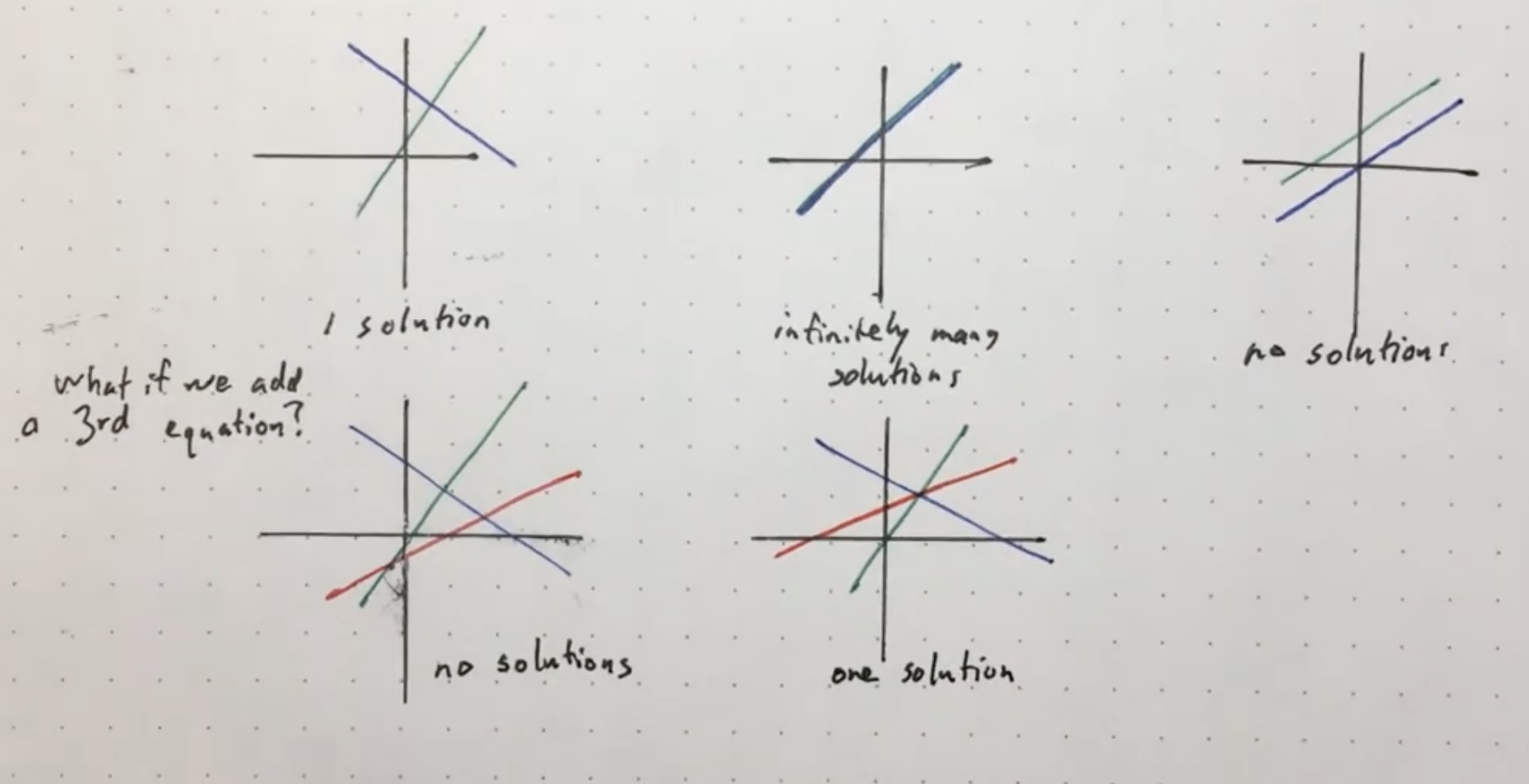 Geometrical representation of a 2D system of equations 1
- Geometrical representation of is a plane in the 3D space
The solution to a system of such equations is the intersection of all the planes.
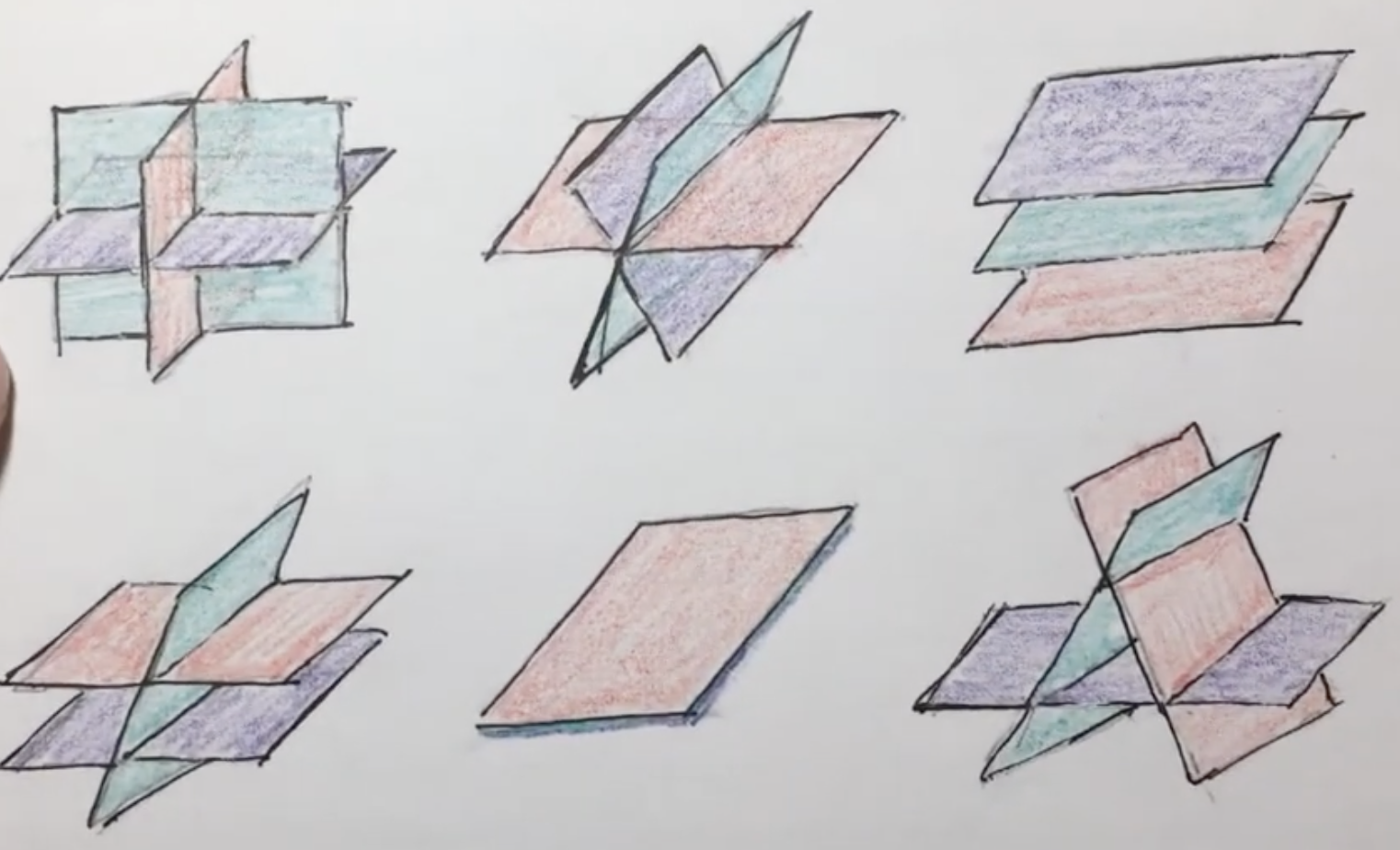 Geometrics representation fo a 3D system of equations 1
- Intersection of 3 planes in 1 point.
- Intersection of 3 planes at. 1line [Infinitely many solutions].
- Parallel panes [no solution].
- No solutions [no exact point where all 3 planes intersect].
- Intersection of all 3 planes on each other [Infinitely many solutions that form a plane].
- No solutions
The answer to this can be thought of from the perspective of 2 planes intersecting at 3 points which leads to the answer being NO.
Parametric Representation
A parameter is an independent variable that acts as a substitute for the set of infinite solutions(In this situation).
Example 5. Find the solution to the given set of equations
	2a - b + 5c - d = -30
	0a + 0b + c + d = -6
Let's take in this scenario. This makes On substituting this into eqn 1.
At this point, let's introduce another parameter so that we can solve for a in terms of s
Now the parametric solution to the solution with s and t as parameters can be represented as
Matrix Representation
Let's try and take the same set of equations from Example 4 and try and solve them through matrices
This system can be represented in a special matrix form called an augmented matrix.
Let's start of by subtracting 3 times equation 1 from equation 2 and 2 times equation 3 from equation 2. The new matrix becomes
Then Let's subtract 2 times the second row from the 3rd row.
From this final matrix, you can then convert it back into equation form and solve for each of the variables. Refer back to example 4 for the exact solution.